Tuesday, 18 June 2013

Everyday prediction of the growth of knowledge (or is it?)


I received the following response to my last post:

When deciding to research a topic, a person may decide that he expects to learn more about a particular subject by using his computer than by reading a book.

But as you point out, it is a contradiction to perfectly know which path to new knowledge is best, because one would have to know all the possible states of knowledge we could possibly have (ahead of time!) to decide perfectly which path we should take. But if we had the knowledge ahead of time, then we wouldn't need to develop it. Instantaneous (timeless) knowledge growth would seem to violate a law of physics.

But when we decide to research a topic using a computer rather than a book, we conjecture a path to new knowledge that we expect to be more efficient. This knowledge is not assumed to infallible, which leads to the above contradictions. One could call a person's ability to guess which path to new knowledge is faster his relative "depth of knowledge". Like other forms of knowledge, knowledge about how to create knowledge is conjectural.

People do form expectations (make predictions) about which type and amount of knowledge will be forthcoming utilizing different techniques, with better accuracy of their predictions depending on their depth of knowledge.

Unless depth of knowledge is a myth, people can form expectations about what will help them learn a particular type of knowledge in a way that is better or faster.  So people can form reasonable expectations about what they will learn.  Can't they?

The argument seems to be that we can predict the effectiveness of different ways of creating knowledge, and we can do this more or less accurately depending on how good are our ideas about it - suggesting that there is an objective form of predictive knowledge about the growth of knowledge itself. One thing to notice about this form of knowledge is that it only allows us to predict at a kind of meta-level. It doesn't say what I will learn in the future - only that (say) the computer will be more helpful than a book.

But more importantly, this argument seems to have assumed that the case against predicting the growth of knowledge is only against infallible prediction. By this account, fallible prediction is possible: I could say the computer would be helpful in my research, and while I might be wrong, this would still be a better conjecture than, say, that watching the Simpsons (or any other  unrelated activity) would be helpful.
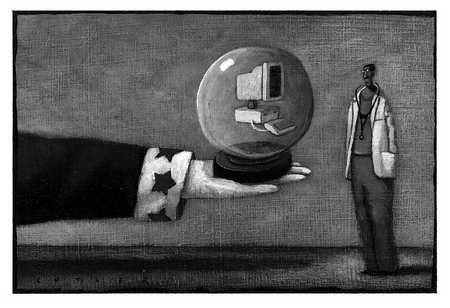
http://thumbnails.illustrationsource.com/huge.25.125786.JPGThere is a crucial difference being overlooked here, and it is not about fallibility. A prediction of how a chemical will react on being exposed to air might be wrong. But this would be because some aspect of the theory that produced the prediction was wrong, or because a measurement (or a background assumption) was wrong. Similarly, the truth of the explanatory theory that the computer is a better source for my research project depends on aspects of the computer and the nature of the research. Yet the predictive claim that I will create more new knowledge if I use the computer is a different thing entirely. I could be right about the former, non-predictive theory about the usefulness of computers, and still be wrong about the latter: I might still learn less by using the computer, for any number of other reasons. For example, it might lead me to get a Facebook account or a video game and spend the whole day procrastinating. Or I might find a wealth of information about another topic and change my whole direction of research. Or I might commit to my original topic and complete the project, with the result that it only impedes the growth of knowledge, because the finished publication perpetuates a violent political ideology.

The problem with predicting the growth of my own knowledge is that it depends not only on objective, unchanging factors, but also on whether I will change my mind. And this is not something I can predict without having the relevant knowledge already. It is true that the more I know about why the computer will be useful and what I will find there, the less my prediction that I will learn more depends on whether I will change my mind. But again, to the extent that I have detailed expectations about what I will find on the computer, this is not a prediction of the growth of knowledge so much as a theory about what information is available on computers.

Saturday, 16 March 2013

On predicting the growth of theoretical knowledge

This can either mean predicting a) that certain theories will be accepted as well tested, or b) that we will derive new explanations or predictions from other theories.

If we predict what theories others will accept, a), the forecast clearly needs to be kept secret from the people in question lest it influence them now (as Popper calls it, the 'Oedipus-effect'). If we keep the prediction secret, either it becomes a prediction from withoutand therefore is not self-predictionor it still requires us to predict that we will keep our results secret. Yet whether we decide to keep our results secret will depend on future circumstances, which in turn depend on the growth of our own knowledgeso to assume we can predict our own adherence to secrecy begs the question of whether self-prediction is possible.

Could we predict the creation of new theories without understanding what we predict? For example, we might describe the shapes of some letters that will be written down, and predict their historical consequences. Arguably this isn't possible either, because if we can predict those shapes, we can write them down now, and if we can write them down now, there is no reason they shouldn't have consequences now. 


Popper argues that we similarly cannot predict the future acceptance of a new theory in the light of new evidence or argument. If that information is available now, the new theory is also available now. If we're talking about evidence that is not presently available, that we can predict its existence using our current theories makes any new theory superfluous.

He also proves that it is impossible even for a Laplacean demon to predict its own future state, as this would involve both describing the initial conditions and describing the future state. To describe its own state 1 hour from now, it would have to describe (1) the inital conditions (required for any prediction task) and (2) all its actions up to that point. (1) takes some amount of timeso it would never be able to predict the future state before it comes to pass.

As for predicting the growth of knowledge in someone else's mind (prediction from without): To do this reliably you would need to know everything that might be relevant to their decisionin other words you would have to possess a significant chunk of all their knowledge. You would have to be superhuman.

So, predicting the growth of knowledge is either self-defeating or practically impossible. (For more, see Karl Popper, The Open Universe, Chapter III, particularly section 21.) Some implications are:

- Free will. If the growth of knowledge could be predicted in principle, so could our decisions, which would make them deterministic. In fact, knowledge creation is unpredictable, and free will is a better explanation for this than 'randomness'.

- When you try to teach or persuade someone of something, the result is unpredictable. If you could predict what ideas the person would have as a result of your teaching, it would not be new knowledge. Yet we know from the theory of  conjecture and refutation that it is new: People only learn by creative conjecture and criticism. I'm not sure if this particular argument holds. It would be interesting to hear others' views on it. But there are also the other problems with predicting the growth of knowledge in other people's mindsthe Oedipus-effect and the sheer complexity of the knowledge that would be required by such a predictor.

Thursday, 28 February 2013

Tuesday, 20 November 2012

Skepticism about skepticism: Is there really a problem of causality?

My philosophy lecturer had a rant* this morning, in which she asserted that no real progress had been made in the area of causality since Hume. On the whole this was a refreshingly true thing to say, yet, in one respect, important progress has been made that she would refuse to recognise, and in another, some of the ‘progress’ to which later philosophers have been aspiring is completely misguided.

Hume’s problem of causation takes a similar form to the problem of induction: Causes are not things we can perceive, just as we could not perceive a principle of induction, so we can’t have knowledge of them from experience—yet since they are a thing in the world, we can’t have a priori knowledge of them either. In very brief outline: For an event to be the cause of another, there has to be a special kind of relation between them, a ‘necessary connexion’ which specifies that the one will always be followed by the other. The relation is unknowable by experience, says Hume, because all we actually perceive is regular succession––certain events continually following certain others (a billiard ball always moving when hit, say). We can’t perceive the relation, so our need to posit it is psychological, and irrational.
Has no progress been made since Hume formulated this problem? Popper pointed out in Objective Knowledge that the problem of causation, while similar in form and even taken by Kant to be the same thing as the problem of induction, is directly refuted by Hume’s ‘negative’ solution to the latter. It is irrational to posit causes only if we assume that knowledge is revealed to us by experience—the ‘bucket theory of knowledge’. In the rest of the aforementioned book, Popper sets out an alternative theory of knowledge that does not require the illogical form of inference that Hume himself rejected. According to this alternative, there is no problem in conjecturing a causal relation, for whatever reason, and seeing if it stands up to criticism (empirical or otherwise).

There is no causality—there is only explanation

So that’s an extremely important respect in which progress has been made. Meanwhile, contemporary philosophers have come up with various theories of the nature of causality. Broadly these can be either mechanistic or difference-making, and either monistic or pluralistic. All of them—including, I suspect, the pluralistic accounts—commit the same basic error: namely, in thinking that there is even a problem to be solved here. They assume that there is a thing in the world called causality or a ‘law of causality’ that universally relates events—or in the case of pluralistic accounts, they assume that there are a few such ‘laws’ for different types of events. Both assumptions are wrong, because causes are simply parts of our explanations** of certain phenomena. Clearly we have different kinds of explanations in different fields. Causes in economics are not the same thing as causes in physics, just as explanations in economics draw on different knowledge from those in physics. The attempt to find a relation common to both fields, or even to define one relation that applies automatically in one and a different kind of relation that applies in the other, is not an interesting problem to solve, because it divorces causes from their explanatory roles. And sometimes we don’t even need causes. They are inapplicable at the level of microscopic physics, for example. F. Russo and J. Williamson recently put forward an ‘epistemic theory of causality', which says, perhaps in agreement with me, that the distinction between mechanistic and difference-making causality is a false dichotomy. There are different kinds of evidence of causality, they say, and it is improper to try to infer causal laws beyond that evidence: “Causality is just the result of this epistemology.” I hope to criticise this alternative in a later post. For now, there is no law of causality: There is only a concept of causality that functions as an explanatory tool.

 *Viz a planned departure from the syllabus to opine in an honest way that is generally more interesting than the rest of the lecture.
** By ‘explanation’ I simply mean accounts of what exists, what it does, and how and why.

Wednesday, 31 October 2012

Part 2: Monarchy for anarcho-capitalists

Since my last post on this, another argument has been brought to my attention. We have, in the United Kingdom, an apolitical head of state. (Some people say that Elizabeth II is just an exception to the general tendency of monarchs to interfere in politics. But she is not so much an exception as a continuation of the development of an apolitical Crown: Most monarchs before her were similarly unprecedented in how little they interfered. It's not impossible that this will change after Prince Charles succeeds to the throne, but it's not very likely. Elizabeth II has established new standards of behaviour for monarchs. Violations of these standards are considered a betrayal of trust, and cause outcry greater than could be provoked by any politician who betrays his promises.) Moreover, the monarchy has evolved to be independent from other parts of government. A distinction is thus set up between the state and the government.

When the government has been entirely privatised, the concept of the state of the United Kingdom could still serve an important purpose. The first anarcho-capitalist society will be surrounded by nation states (we can all agree that a worldwide transition to anarchy is comparatively implausible).  There will need to be a clear political boundary between it and those other states, much as we need established boundaries between states now for international law to function. The border of the ancap 'state' couldn't be completely free, because this would allow, in principle, for people to flood in from outside, be lawless, and overwhelm and destroy the ancap system. People would have to recognise the  legitimacy of this border. So the monarchy would serve the same purpose in an ancap society as it does now: namely, to maintain traditions of legitimacy and to be a symbol of the sovereignty of the UK.

Wednesday, 24 October 2012

Why libertarians should support the monarchy (part 1)

As the Diamond Jubilee year draws to an end, examples mount up of Andrew Marr's reinterpretation earlier this year of the monarchy with the Queen as our "department of friendliness," in the wake of the intense Jubilee programme. Marr's description is admittedly cringy. But is it wrong?

 What the monarchy is not
First I’ll look at some arguments inspired by this blog post, and show that there is no libertarian case against the monarchy in Britain.
Expensive
That the monarchy is a cost to the taxpayer is a common misconception. While the real amount spent on the monarchy is somewhat debatable if we take into account the cost of security and so on, the revenues from the Crown Estate more than make up for it. As of last year, 85% of this revenue goes to the government, and the other 15% goes to the Queen, to whom the land actually belongs. So in actual fact, for the last 250 years the monarch has effectively had to give money to the taxpayer (in return for an allowance), not the other way around.
A libertarian might still object to the Crown Estate because it is not strictly private property—it’s a statutory corporation, accountable to Parliament, which the Queen is not allowed to sell. So the land is effectively nationalised. If it were available to the private market the land might generate more wealth than it does in its current 'nationalised' state. For a start, this is a somewhat dubious counterfactual, as the Crown Estate has actually been doing rather well: profits from this land have risen in the last year (see Crown Estate website link above). But as we shall see, even conceding this point, it is still not a good reason to oppose the monarchy.
Coercive
Nor can we object to it from the perspective of property rights. George III voluntarily gave up the income from the Crown lands, and this agreement has been voluntarily continued by successive monarchs. There are no identifiable private owners who are being forced to give up their property to the state (as is the case for actual nationalised industries).
And even if there were such a grievance, this is still only an objection to how the monarchy is set up financially, not to the institution itself—which could perfectly well still exist under some other arrangement, as it eventually will as it continues to evolve. I similarly object to how the military and the NHS are funded; I’m not opposed to armies and hospitals. I merely hope and expect that as these institutions are improved, they will gradually be privatised. Given the comparative success of the Crown Estate, and given its voluntary nature, there should be less reason to abolish it on financial grounds, not more. Why do anti-monarchist libertarians commit this double standard? I suppose it is part of a deeper error that will presently be treated.
Improper
It is not the job of the government to make money, so it has no business accepting the revenues of the Crown lands.*
This argument contains the methodological assumption that to decide whether a policy is right, one first chooses a set of principles and then derives policy from them. So, a libertarian who takes this approach might conclude that the state’s proper functions are to run the police and the military and nothing else, and oppose the existence of all other government institutions on those grounds. It is true that as these things are improved, they will eventually be privatised (if you don’t agree, accept it here for the sake of argument). But it is profoundly untrue that we should decide whether to support a policy by checking it against a principle, and oppose it if it’s not allowed by the principle. This is dogmatic: It has to assume that the principle is infallible, as it is being treated as the ultimate authority on the rightness or wrongness of a given policy. Treating it as an authority makes it difficult or impossible for the principle itself to be improved.
This utopian methodology fails to take into account that it is harder to create knowledge than to destroy it.  This means that less knowledge will be embodied in our institutions if they are all completely revamped every time the principles of government are changed, abolishing everything that doesn’t fit that utopian criterion. Even without one of these Ultimate Libertarian (/insert other political persuasion here) principles, one might wish to have abolished anything that seems to exist without an explicit reason of some kind. But this is also dogmatic: We don’t know what the value is of many of our traditions. It’s wrong to assume that failing to name their value entails that they are worthless. Countless rules of grammar don’t appear to have explicit motivations, but if we started revising the English language on those grounds we would end up with a language not dissimilar to Newspeak.
The better approach—and the one on which England bases its success as a civilisation—is to retain a given tradition until and unless a problem is found with it (an actual problem—not merely a failure to live up to utopian criteria or articulated justification). Tradition is existing knowledge. Much of this knowledge is not explicit; we don’t consciously know the reasons behind many rules and ceremonies. It is for this reason that people who call for the monarchy to be abolishedrather than altered in certain waysare so woefully mistaken. It would be easy to wipe it away, along with other government institutions, and replace it with a government derived from libertarian principlesbut there is danger in that ease. 

* Quoted from this post.

Saturday, 25 August 2012

Free will: Misconceptions answered

Having established the problems with reductionism, and having established a need to explain the 'world' of abstract ideas on a higher-than-deterministic level, let's turn to some of the more common determinist and compatibilist claims about free will.
An action is only free if it was possible to do otherwise. Our thoughts consist of activity in the brain, which is a purely physical phenomenon. Physical activity is either random or deterministic – so our thoughts are either physically inevitable (determined) or controlled by random factors. Neither of these allow for free will.
For a start, this isn't very helpful in itself. Like solipsism, it merely proclaims the non-existence of something, not because it's a bad explanation, but just because of an apparent logical difficulty. It denounces a host of experiences as illusory, closing off the possibility of finding better explanations for them. It's not a good approach.

It's also a reductionist argument. It assumes that people's choices must be explained in terms of low-level interactions, as if this form of explanation were more 'fundamental'.  Even if we did know all the (inconceivably many) physical events that led to a certain thought, they wouldn't be a good explanation of why the person had that thought. If I think to myself, 'I need to write a blog post', the reason I had that thought could be explained as, 'Because X neurons fired off in Y and Z locations' – but this only tells us what physically prompted my thought.  It was already clear that neurons needed to signal in order for me to have had a thought. So it tells us nothing we didn't know already.


Fine, some stuff is emergent. But still, every effect has a cause. Even if my thoughts and actions are caused by emergent ideas and circumstances, according to causality they're still unavoidable. So for every decision I make, I couldn't have done otherwise.
People are creative. Ideas change, technology progresses, all the time people form new theories in the light of criticism. It doesn't make sense to talk about creativity in terms of sufficient causes, because if a new idea could be inferred from something that went before, that thing would contain the idea – and so it wouldn't be new at all. The future is unavoidable only on a lower level of explanation with respect to that of knowledge-creators. On the abstract level of creative thought, causal determinism isn't applicable. It is true that there is always a single answer to questions about what *physical* state something will be in in the future. Physically it is determined. But on the emergent level of knowledge creation the future has to be open.
But you don't know what your thoughts are going to be before you think them. And you can't be in control of something if you can't predict what it's going to do, surely. So how can you be in control of your thoughts?
Again, if you could predict your own thoughts, those predictions would be the thoughts themselves. There's no real reason to think you can't be in control of a thought as you're having it, though it didn't occur to you to have it beforehand. We pursue certain trains of thought purposefully: we can freely intend to come to a conclusion without knowing in advance what the conclusion will be. This doesn't imply a lack of control; it just implies creativity.
People are free in the sense that they have evitability: They can alter their courses of action according to projected consequences. Even if at the micro-level we are behaving deterministically, we're still free in the sense that matters.
This view of free will would mean that a simple computer program could have a little bit of that which makes humans free. It is true that computers can be programmed to follow abstract rules, such that their activities couldn't be explained in purely physical terms. But human freedom is on a higher level of emergence than that, because of creativity. If we were 'free' in the same way as that computer program, just to a higher degree, our actions would be predictable in principle and hence determined. So there's more to it than having purpose and 'evitability'.